
A Healthcare System Buckled Under Its Own Weight
By 2020, emergency departments across America had become the default primary care provider for millions of people who had nowhere else to go. The ER — designed for life-threatening emergencies — was drowning in non-emergency visits.
The consequences were systemic and severe. EMS units responded to calls for headaches, minor infections, and anxiety attacks while genuine emergencies waited. A single ER visit cost between $2,000 and $10,000. Wait times stretched from three to six hours. And in rural areas and elderly homebound communities, the emergency department wasn't even accessible — it was still the only option.
EMS resources were being consumed by non-emergencies, delaying response for patients who genuinely needed them. Rural and homebound populations had no alternative. And hospital systems were paying the price — operationally, financially, and in patient outcomes.
Eliminating the ER Dependency — Without Sacrificing Clinical Standards
Prime Orlando Healthcare, operating within the Integrated Telemedicine and Emergency Medicine (InTeEM) framework, approached Medlogics with a clear mandate: build a mobile, physician-level care delivery model that could reach patients wherever they were — and make the emergency room optional for the non-critical majority.
The challenges were formidable. Rural and homebound populations had no pathway to routine or urgent care outside of calling 911. Non-emergent cases were overwhelming EMS dispatch, stretching response times for true emergencies. And existing tools — telemedicine, billing, clinical documentation, and operations — lived in disconnected silos with no real-time synchronization between clinical and financial workflows.
"Any organization can put a camera and a laptop in a van. The difference was a unified platform that connected every touchpoint of the care delivery chain in real time."
— Prime Orlando Healthcare, Implementation TeamA Fleet of Mobile Clinics. One Unified Platform.
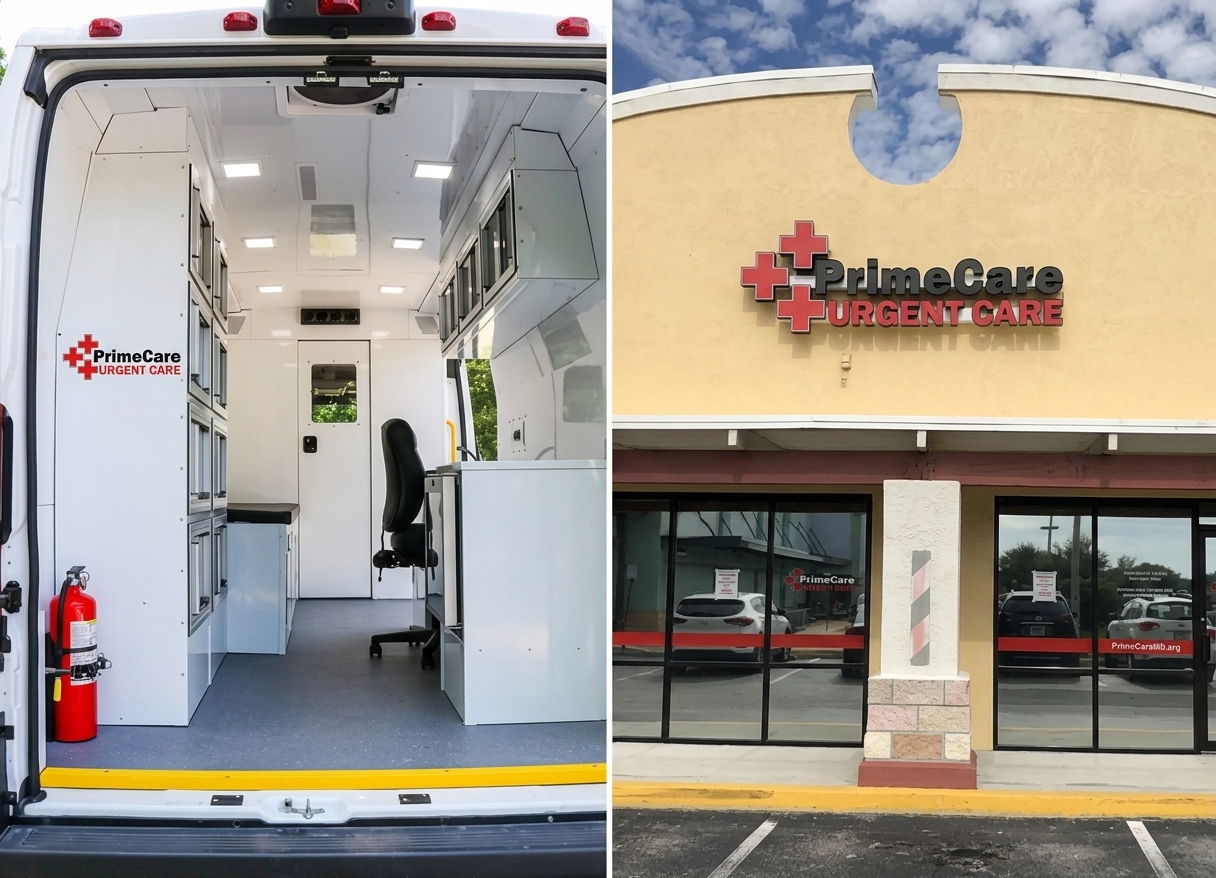
The concept was bold: a fleet of fully equipped Telemedicine Medical Vans — mobile urgent care units capable of delivering ER-level diagnostics and treatment at the patient's location. Each van would function as an autonomous clinical facility, connected in real time to remote physicians via HD video.
Medlogics served as the central nervous system. Not a telemedicine bolt-on. Not a separate billing system. One platform that unified clinical workflows, automated billing, managed dispatch logistics, and gave every stakeholder a single source of truth.
Hardware Deployed in Each Van
- Panasonic Toughbook and Dell Rugged laptops for field-condition durability
- Logitech PTZ Pro and Cisco TelePresence for HD physician video consultations
- Thinklabs and Eko digital stethoscopes; portable EKG devices
- Welch Allyn and Philips vital sign monitors for comprehensive onsite assessment
- Redundant 4G/5G cellular routers with automatic failover for uninterrupted connectivity
Medlogics tied it all together with three core capabilities: real-time teleconsultation and clinical documentation for the physician workflow; automated medical coding, insurance verification, and claims processing for the billing workflow; and intelligent van scheduling with geo-based patient routing for the operations workflow.
Every encounter generated its corresponding billing event automatically. Every clinical decision was documented in real time. Every van's location, status, and patient load was visible to dispatch in a single dashboard.
The Hospital Came to the Patient
A patient in a rural area doesn't call 911. They call the TeleCare dispatch line. What happened next changed the model entirely.
The dispatch system received the call, triaged the request, and assigned the nearest available van based on location, urgency, and clinical need. Within minutes, a fully equipped mobile unit arrived. A trained community paramedic began onsite assessment — vitals, history, presenting symptoms.
A board-certified emergency physician connected via live HD video, reviewing real-time diagnostic data and the paramedic's assessment within the Medlogics interface. Diagnostics were conducted onsite. Treatment was initiated immediately — medications administered, prescriptions generated, specialist referrals made if needed.
Community paramedics operated in a dual capacity — as primary care extenders and emergency responders. Patients could be treated entirely on-site or connected to specialists remotely. The result: ER-level care at the patient's location. No ambulance ride. No six-hour wait. No $5,000 bill.
The Numbers Told the Story
The results across operational, financial, and clinical dimensions validated the model completely. Non-emergency EMS dispatches dropped by 60% as patients were routed to the mobile service instead. Critical emergency response times improved as EMS units were freed for genuine emergencies.
Per-encounter cost was reduced to less than 25% of a standard ER visit. Unnecessary hospital admissions dropped substantially. Automated billing workflows through Medlogics increased revenue capture and eliminated coding errors that had previously leaked thousands of dollars per month.
Homebound and elderly patients received routine care without the burden of hospital travel. Patient satisfaction scores exceeded benchmarks across all demographics. Rural healthcare access expanded to communities that had previously depended on emergency services for basic care.
"Before Medlogics, our billing and lab systems were on different computers running different software. Now everything talks to each other — and it keeps working even when the internet goes down. That’s not a feature, that’s a lifeline."
— Administrator, Prime Orlando HealthcareThis Wasn't a Telemedicine Deployment. It Was a Paradigm Shift.
The traditional model asked patients to come to healthcare. This model brought healthcare to patients — wherever they were, whenever they needed it.
And at the center of it all, Medlogics turned a moving vehicle into a fully functional, revenue-generating, life-saving healthcare unit. From "patients travel to care" to "care travels to patients" — enabled entirely by software that unified what had always been fragmented.
The scalability of this model wasn't in the hardware. It was in the intelligence behind it: a platform that automated the operational, clinical, and financial layers of mobile care delivery so that teams could focus entirely on the patient in front of them.